- Marketoonist Newsletter
- Posts
- Marketoonist: "5 Stages of AI Adoption" cartoon
Marketoonist: "5 Stages of AI Adoption" cartoon
Weekly hand-drawn business cartoon from Marketoonist Tom Fishburne

Tom Fishburne
February 02, 2026
Welcome back to Marketoonist, the cartoon I’ve been hand-drawing to poke fun at marketing and business nearly every week since 2002. Was this email forwarded to you? Please subscribe here.
5 Stages of AI Adoption

Steve Jobs famously described the computer as a "bicycle for the mind."
Last week, my old friend Jason Copeland invited me to join a Silicon Valley roundtable he moderated with a fascinating topic:
"Will AI be a bicycle for the mind? Or an autopilot to which we passively delegate human judgment and creativity?
"We're biologically hardwired to adopt tools that free us for other work. Yet unlike calculators or GPS, AI is a general-purpose 'thinking' tool that threatens to offload core aspects of human cognition, judgment, and learning.
"Over-reliance risks atrophying our critical thinking skills."
The gathering brought together a small group of big tech leaders, startup founders, designers, investors, journalists (and one cartoonist) to talk about some of these implications of AI on work and society.
I left with a greater sense of urgency on how quickly AI will likely impact the nature of work. And also an appreciation for the level of soul-searching needed to figure out how to use AI as a "bicycle of the mind" not an "autopilot."
Axios CEO Jim VandeHei wrote a personal letter to his kids about AI that he shared publicly last week. It included this line:
"Saddle up and figure out fast how to turn AI into a force multiplier of your dreams."
In a later video, he expanded on this idea:
"[Use AI as] an extension of the work that you do. Don't let it be a replacement. Otherwise you're just going to be a boring lemming. And no one's looking for boring lemmings. So you want to keep what makes you unique. Use AI as a force multiplier."
Whether AI is a “bicycle of the mind” (force multiplier) or an “autopilot” (replacement) will depend on how we choose to use it.
The path of least resistance is homogeneity when everyone has access to the same tools. Leveraging AI in novel ways requires novel human thinking.
Quick Keynote Update
I just confirmed a speaking event this November in New Zealand. This will be my first-ever trip to New Zealand (and hopefully Australia). I’d love to hear if anyone has any ideas for other speaking events in New Zealand or Australia in early to mid-November so that I can make the most of my time there.
Last week, I spoke at internal data privacy conference for an iconic fashion brand and this week I’m recording a session for CIO’s that will air in mid-February (more details soon).
As always, please let me know if you’d like to talk about any events you’re planning (or know of) that you think could be a good fit for some cartoon levity and insight.
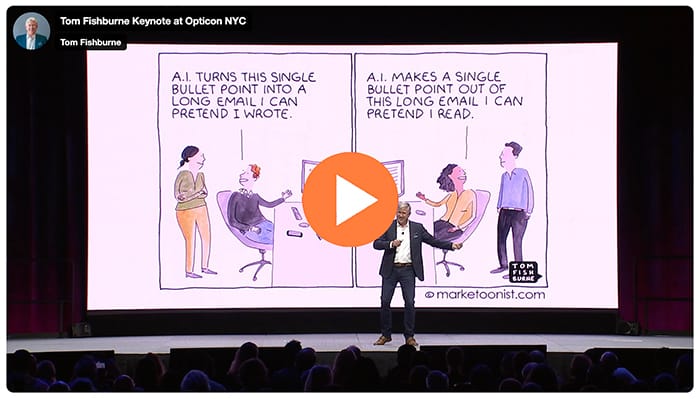
For an idea of my approach to keynotes, here’s a full 30-minute keynote from one of my favorite events last year — Opticon 2025 hosted by Optimizely:
Cartoon From The Archives
Here’s a related cartoon I drew in 2024. And here’s where you can read and search all 23 years of these cartoons.

Thank you for all of your support (and cartoon material)!
-Tom
P.S. If you like these marketoons, here are a few ways to help:
License cartoons for presentations or more (if a picture tells a thousand words, a marketoon tells a thousand boring PowerPoint slides)
Forward this newsletter to a friend with an invitation to subscribe: marketoonist.com/newsletter.
Collaborate with me on cartoons for marketing, culture change, or thought leadership
Just hit reply and say hello
About Marketoonist

Marketoonist is the thought bubble of me, Tom Fishburne. I first started drawing cartoons as a student in the Harvard Business School newspaper (not quite as well-known for humor as the Lampoon) and later started this newsletter from a General Mills cubicle in 2002. The cartoons have followed my career ever since. I poke fun at the ever-changing world of marketing and business because I believe that laughing at ourselves can help us do our best work.