- Marketoonist Newsletter
- Posts
- Marketoonist: "Advertising, Brand Recall, and Celebrities" cartoon
Marketoonist: "Advertising, Brand Recall, and Celebrities" cartoon
Weekly hand-drawn business cartoon from Marketoonist Tom Fishburne

Tom Fishburne
February 09, 2026
Welcome back to Marketoonist, the cartoon I’ve been hand-drawing to poke fun at marketing and business nearly every week since 2002. Was this email forwarded to you? Please subscribe here.
Advertising, Brand Recall, and Celebrities

Super Bowl ads have always juggled story power and star power. But the overall swing toward celebrities has been an ongoing trend.
In 2010, just 31% of Super Bowl ads included a famous face. Last year, a whopping 68% of Super Bowl ads featured celebrities and 51% featured multiple celebrities, according to iSpot.tv and EMARKETER.
(I haven't seen the final numbers for 2026, but early teasers looked like another big celebrity year.)
With all the positive things that celebrities can bring to an ad (attention, humor, trust, status, etc.), the big risk has always been that celebrities overshadow the brand.
In the 80s, Robin Evans first termed this risk as the "vampire effect."
My old friends at System1 track Super Bowl ads on a number of dimensions, including "Fluency" -- the accuracy and speed of brand recognition.
System1 Head of Marketing Jess Messenger summarized their findings on celebrity and brand recall recently:
"In 2025, the average Fluency Rating for Super Bowl ads was a modest 78, meaning, on average, 22% of viewers couldn’t correctly name the brand after watching the ad.
"Of the top 10 Big Game ads for Fluency, three leveraged well-known stars and one featured a group of influencers. Meanwhile, six of the top 10 ads did not use celebrities."
At an $8 million ad spend for 30 seconds, the stakes of poor brand recall in the Super Bowl are high. But the importance of paying attention to "Fluency" is relevant for marketers at all spend levels.
The celebrity lever is one of the easiest to pull. But too many ads use celebrities shallowly, interchangeably, and as a one-off. And when 68% of Super Bowl ads use celebrities, celebrities alone are not going the move the needle.
As I've written before, we can't break through the clutter by adding to it.
Quick Keynote Update
I just confirmed I’m speaking at Experience Inbound in Wisconsin this Spring: two back-to-back dates in two cities (April 28 in Milwaukee and April 29 in Green Bay).
Early in my marketing career, I spent a lot of time in Milwaukee. One of my very first clients was the beloved (but now defunct) Midwest Express Airlines (they had no middle seats and used to bake chocolate chip cookies on every flight). I look forward to getting back to Wisconsin.
And thanks to everyone last week who shared ideas for things to do in New Zealand when I’m there to speak at a conference in November. More details soon.
As always, please let me know if you’d like to talk about any events you’re planning (or know of) that you think could be a good fit for some cartoon levity and insight.
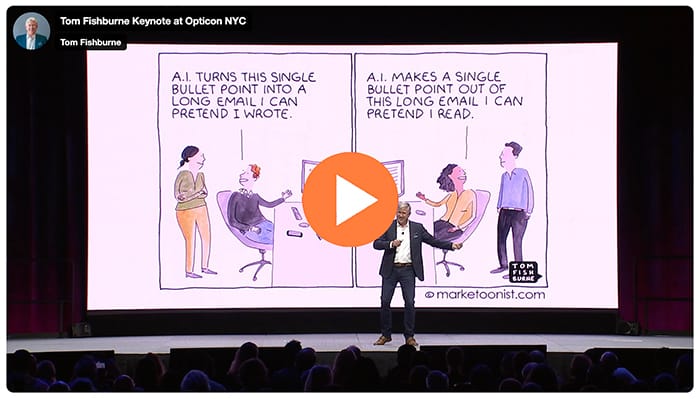
For an idea of my approach to keynotes, here’s a full 30-minute keynote from one of my favorite events last year — Opticon 2025 hosted by Optimizely:
Cartoon From The Archives
Here’s a related cartoon I drew in 2018. And here’s where you can read and search all 23 years of these cartoons.

Thank you for all of your support (and cartoon material)!
-Tom
P.S. If you like these marketoons, here are a few ways to help:
License cartoons for presentations or more (if a picture tells a thousand words, a marketoon tells a thousand boring PowerPoint slides)
Forward this newsletter to a friend with an invitation to subscribe: marketoonist.com/newsletter.
Collaborate with me on cartoons for marketing, culture change, or thought leadership
Just hit reply and say hello
About Marketoonist

Marketoonist is the thought bubble of me, Tom Fishburne. I first started drawing cartoons as a student in the Harvard Business School newspaper (not quite as well-known for humor as the Lampoon) and later started this newsletter from a General Mills cubicle in 2002. The cartoons have followed my career ever since. I poke fun at the ever-changing world of marketing and business because I believe that laughing at ourselves can help us do our best work.