- Marketoonist Newsletter
- Posts
- Marketoonist: "Customer Personas" cartoon
Marketoonist: "Customer Personas" cartoon
Weekly hand-drawn business cartoon from Marketoonist Tom Fishburne

Tom Fishburne
January 26, 2026
Welcome back to Marketoonist, the cartoon I’ve been hand-drawing to poke fun at marketing and business nearly every week since 2002. Was this email forwarded to you? Please subscribe here.
Customer Personas
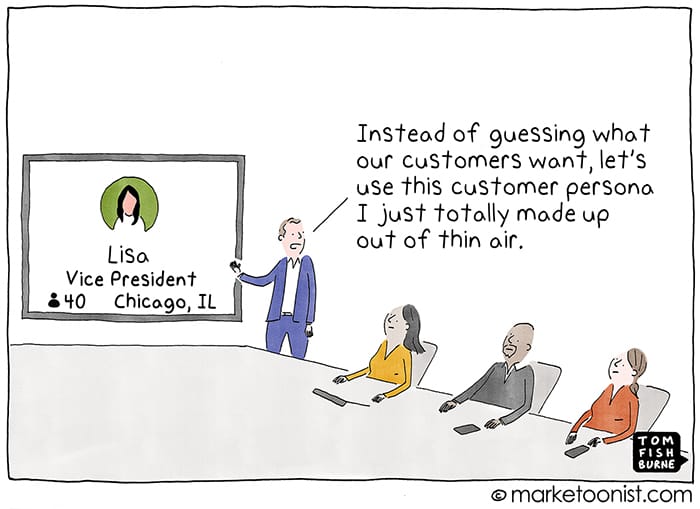
Marketers use have long used personas as a tool to try to bring customers into the room -- to help organizations be more customer-centric. They’re intended to help with everything from innovation to experience design to marketing and sales.
A software engineer named Alan Cooper is credited with creating the first persona in 1985. Looking for a better way to design software, he invented "Kathy" as a synthesis of all of the customer interviews he'd made. Ogilvy later popularized personas as a marketing tool in the mid-90s.
At their best, personas can help visualize and communicate insights from research.
But at their worst, they have nothing to do with the real world, let alone real people. Personas sometimes say more about the team that created them than about the customers or users they’re supposed to represent.
And, yet, because they look so authoritative, these bogus personas can give false confidence to marketers trying to deliver what customers want.
In the last few years, AI-generated synthetic personas have emerged as a viable mainstream alternative to traditional personas. Companies like Evidenza and Synthetic Users create synthetic personas from large datasets that simulate a target audience. You can engage, interview, and survey them like real people. And particularly for hard to access audiences like senior execs, this gives access that didn't exist before.
EY ran a test with Evidenza to run their annual brand survey, and found a 95% correlation between the research with synthetic personas and research with real customers. Instead of the traditional 6-8 weeks, research with synthetic personas took a day or two.
And yet any research tool is only as strong as the training data. Asking a general-purpose LLM like ChatGPT to simulate a VP of Engineering persona will give plausible-sounding answers, but the answers may not be credible.
With any Generative AI outputs, we always have to watch out for what Greg Kihlstrom termed "confident nonsense."
I like how design leader Julian Scaff wrote about the limits of synthetic personas recently:
"Human-centered design depends on listening, confronting difference, and engaging with uncertainty. Synthetic personas may offer the comfort of coherence, but they cannot reveal what we do not already assume. If we allow simulation to stand in for human engagement, we risk building systems optimized for fictional users, artifacts of our own biases, rather than for the complex, contradictory humans design claims to serve."
Podcast Conversation on The Secret to Great Creative Work
I’ve been a fan of Drew McLellan and the Agency Management Institute for a while. Drew’s podcast, Build A Better Agency, is an incredible resource for agency owners.
Drew and I had a great conversation that just dropped on creativity, agency culture, humor, and pushing past predictable ideas. Listen on Apple, Spotify, and iHeart Radio.

Cartoon From The Archives
Here’s a cartoon I drew about personas in 2016. And here’s where you can read and search all 23 years of these cartoons.

Thank you for all of your support (and cartoon material)!
-Tom
P.S. If you like these marketoons, here are a few ways to help:
License cartoons for presentations or more (if a picture tells a thousand words, a marketoon tells a thousand boring PowerPoint slides)
Forward this newsletter to a friend with an invitation to subscribe: marketoonist.com/newsletter.
Collaborate with me on cartoons for marketing, culture change, or thought leadership
Just hit reply and say hello
About Marketoonist

Marketoonist is the thought bubble of me, Tom Fishburne. I first started drawing cartoons as a student in the Harvard Business School newspaper (not quite as well-known for humor as the Lampoon) and later started this newsletter from a General Mills cubicle in 2002. The cartoons have followed my career ever since. I poke fun at the ever-changing world of marketing and business because I believe that laughing at ourselves can help us do our best work.